





The latest 189 invitation round has gone viral again! Many people messaged us asking:“Exactly how many points do I need to get invited?” “Which occupations were picked?” “Is 189 really the hardest migration pathway?”
So—here is the newest invitation list + points summary. And we’ll also explain what the 189 visa actually is, who it suits, and what you need to prepare.
What Is the Subclass 189 Skilled Independent Visa?
In one sentence: No employer sponsorship. No state nomination. No requirement on where you work. Your eligibility is based purely on:Qualification;Occupation;English level;Age;EOI points score。If you receive an invitation → you are on the PR pathway.Meaning: ❌ No employer lock-in ❌ No regional restrictions ✔️ Direct PR in one stepIt is the most “free” migration pathway in Australia. But “freedom” also means extremely high competition.
Let’s be realistic: 189 is NOT designed for everyone. It is for — high scorers + in-demand skilled applicants.
Real Invitation Points from This Round
These data come from our internal tracking plus publicly available sources, provided for trend analysis.
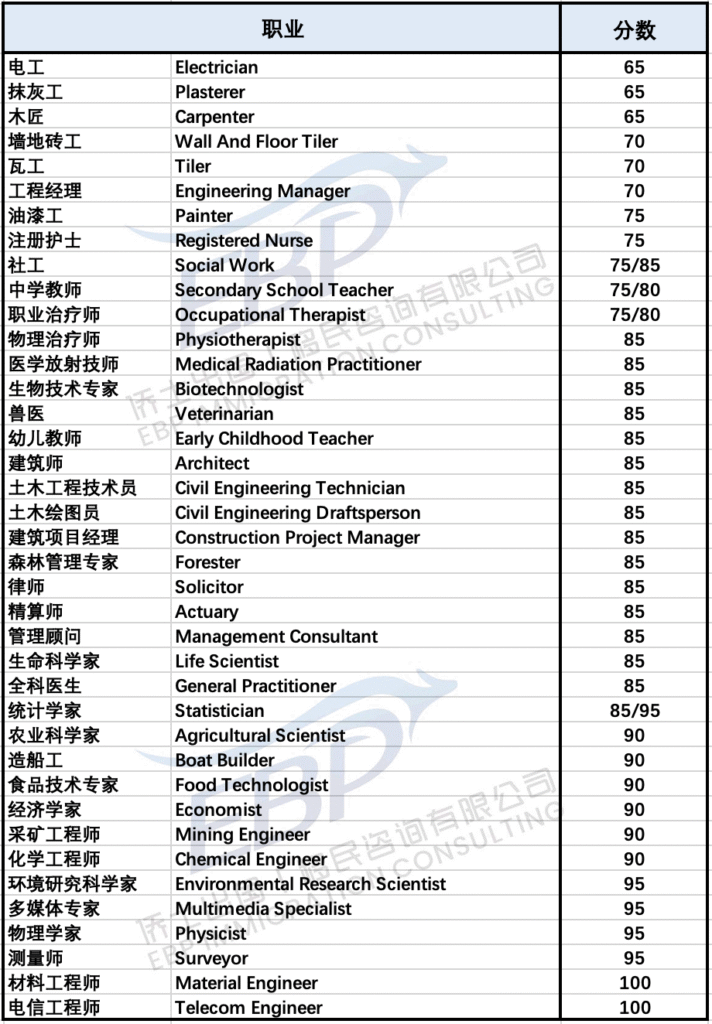
The most shocking part: Some occupations needed 95–100+ points to get invited.
Why Are the Required Points So Different?Because 189 is an invitation-based system:
- Occupation demand
- EOI ranking
- Points from English / qualification / age
- Whether you’re onshore or offshore
- Number of competitors in the occupation pool
All influence who gets invited first.In short: 189 is not “who meets the requirement gets invited.” It is: “who is stronger gets picked first.”
Who Should Consider Targeting 189?If you fall into ANY of these three categories, your chances are strong:
- ✓ Medical & HealthcareNurses, doctors, physiotherapists, radiographers
- ✓ STEM fields,Engineering, IT, research, mathematics & statistics
- ✓ Trades,Electricians, carpenters, bricklayers, automotive, telecom installers
Especially strong candidates include:Health-care related professionals.Regional STEM graduates.Applicants with many years of overseas experience. These people have significant competitive advantage.
Recommended Strategy: Don’t Rush—Plan.Before applying for 189, ask yourself these three questions:
| Question | Your Answer |
| ① Do you have a valid skills assessment? | Yes/No |
| ② How many EOI points do you have? | ? |
| ③ Do you want to wait for opportunities or create opportunities? | ? |
If your answers are:
“High score ≥ 85” → You can wait for an invitation
“Score ≥ 70 but unstable” → Consider adding 190/491/state nomination
“Score not enough but can be improved” → Study more / gain experience / take PTE
Migration is never a single pathway. 189 can be a goal, but it should never be a blind belief.
Final NoteThe 189 visa is never for people who “just want to try.” It is for people who are prepared.If you want to know:
Whether your points are competitive
Whether you have room to increase your points
Whether you should target 189 or switch to 491/190/482/186
Whether applying offshore or onshore is better
We will provide you with a clear and actionable migration roadmap — Not a template, but a personalised one designed for you.