




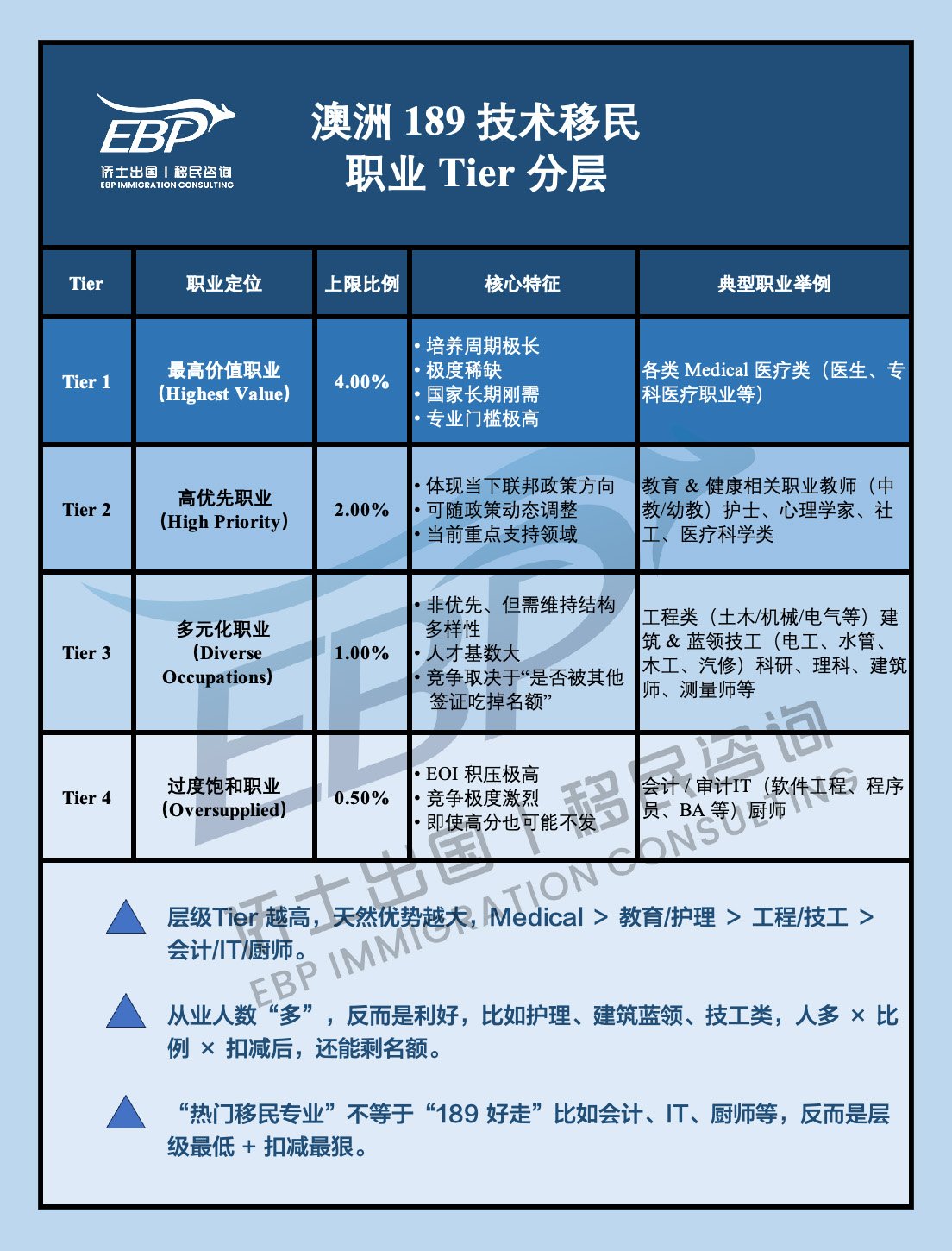
Many people believe that the 189 Skilled Independent visa is simply about points. But in reality, over the past few years, which occupational Tier you fall into has become more important than how many points you score.This Tier-based occupation framework is the key to understanding how invitations actually work.
I. The 189 Visa Has Entered the “Occupation Tier Era”
The 189 visa is no longer about “highest points wins.” Instead, the logic is:
- Occupations are ranked by Tier
- Competition happens within each Tier
- Each Tier has an implicit quota ratio
The official invitation logic can be understood simply as:Tier determines whether you are considered at all; points only determine your ranking within that Tier.
II. Full Breakdown of the Four 189 Occupation Tiers(You must match yourself correctly)
Tier 1 | Highest Value Occupations,Quota ratio: ~4% (but with the highest priority)Key characteristics:
- Extremely long training pathways
- Severe national shortages
- Long-term strategic demand
- Very high professional thresholds
Typical occupations:
- 各类 Medical 医疗类
- 医生
- 专科医疗人员
- 高端医疗专业岗位
One-line conclusion: Tier 1 occupations are not about competing on points — the country is actively seeking you.
Tier 2 | High Priority OccupationsQuota ratio: ~2%
Key characteristics:
- Clearly aligned with current government policy directions
- Can be adjusted dynamically based on policy needs
- Actively supported sectors
Typical occupations:
- Education (Secondary Teachers / Early Childhood Teachers)
- Nurses
- Psychologists
- Social Workers
- Medical science–related occupations
One-line conclusion: Tier 2 is the most realistic and stable 189 pathway for ordinary applicants.
Tier 3 | Diverse OccupationsQuota ratio: ~1%
Key characteristics:
- Not priority, but necessary for maintaining industry balance
- Large workforce base
- Invitation likelihood depends on whether demand is diverted to other visas
Typical occupations:
- Engineering (Civil / Mechanical / Electrical, etc.)
- 建筑 & 蓝领技工
- 电工、水管、木工
- 汽修
- Scientific research roles
- Architects, surveyors
One-line conclusion: Tier 3 is not bad — it’s about competing for what remains.
Tier 4 | Oversupplied OccupationsQuota ratio: ~0.5% (the lowest)
Key characteristics:
- Extremely high EOI backlogs
- Intense competition
- Even high scores may wait years without invitations
Typical occupations:
- Accountants / Auditors
- IT roles (Software Engineers, Programmers, Business Analysts, etc.)
- Chefs
One-line conclusion: Tier 4 means working the hardest, but most likely to miss out.
三、三个被严重误解的 189 真相
III. Three Widely Misunderstood Truths About the 189 Visa Misconception 1:“Lower Tier means fewer people, so it must be easier.” Wrong.In reality, large workforce numbers do not automatically mean harder migration. What matters is:After Tier-based reductions, are there still places left?
For example:
- Nursing
- Construction trades
- Skilled blue-collar occupations
These have large numbers but also large quotas and genuine demand, so invitations are still possible.
Misconception 2:“Popular migration majors are good for the 189.” Completely wrong.
Accounting, IT, and chefs:
- Look popular
- Sit in the lowest Tier with the heaviest quota cuts
Result: EOIs pile up, invitations become rarer.
Misconception 3:“As long as my points are high enough, the 189 will be granted.” Not true.Tier determines whether you are even considered. Points are only a ranking tool, not a guarantee.
IV. One-Sentence Summary
- The higher the Tier, the stronger the inherent advantage,Medical > Education / Nursing > Engineering / Trades > Accounting / IT / Chefs
- Choosing the right occupation matters more than chasing points
- The 189 visa has never been a “fair-for-everyone” program