




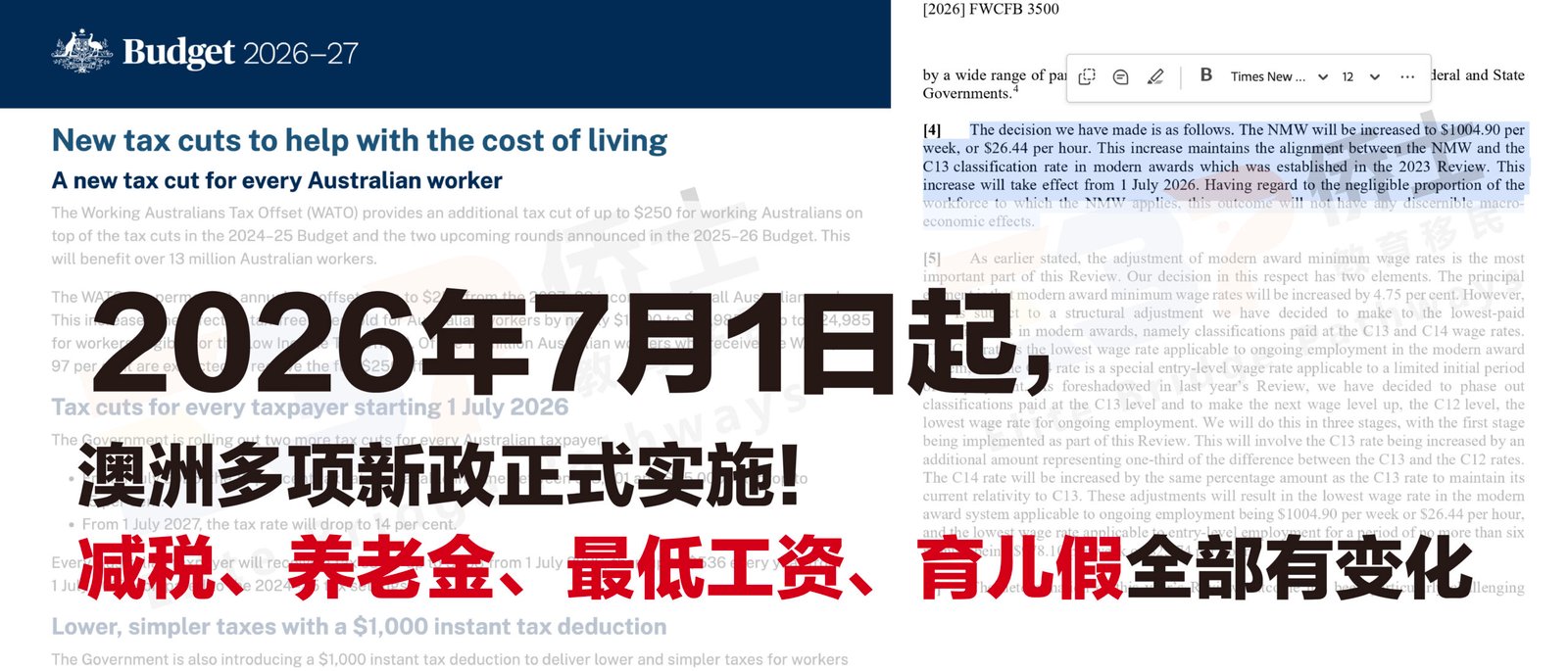
1 July marks the start of Australia’s new financial year and the annual rollout of sweeping policy adjustments, and 2026 is no exception. Starting 1 July 2026, Australia will implement major updates covering income tax, superannuation, national minimum wage and government-funded Paid Parental Leave. These reforms are essential reading for anyone working, studying or planning to migrate to Australia.
I. Further Personal Income Tax Cuts to Boost Take-Home Pay
One flagship reform is the new round of personal tax relief. For taxpayers with a taxable income between AUD 18,201 and AUD 45,000, the marginal tax rate will drop from 16% to 15%. Though a single percentage point reduction, it delivers annual tax savings for eligible individuals. Key groups set to benefit directly: Recent graduates entering the workforce, International students working part-time, Full-time workers on lower incomes, Note: This rate adjustment only applies to earnings within the AUD 18,201–45,000 bracket. Income above AUD 45,000 remains taxed at the existing marginal rates.
II. Superannuation Enters the Payday Super Era
1 July will launch the most significant superannuation reform in recent years: Payday Super. Previously, most businesses made super guarantee (SG) contributions quarterly. Employees received wages monthly, yet super funds might not receive contributions for months afterwards. This system will be overhauled under the new rules. Under Payday Super legislation, employers must ensure super contributions reach an employee’s nominated super fund within 7 business days of payday. The key benefits for workers include: Faster deposit of superannuation funds, Longer investment periods for compound growth, Easier detection of unpaid or delayed super ,contributions from employers, For long-term Australian workers, earlier super deposits compound over decades, substantially boosting final retirement balances.
III. National Minimum Wage Rises Again
The Fair Work Commission has confirmed a nationwide minimum wage increase effective 1 July 2026.
Updated statutory pay rates:
- Minimum hourly wage: AUD 26.44 per hour
- Minimum weekly wage (38-hour full-time roster): AUD 1,004.90
This represents a 4.75% year-on-year increase. Importantly, the new pay scales apply from the first full pay cycle falling on or after 1 July — workers will not automatically see higher pay on 1 July itself.
Industries and workers most impacted:
- Hospitality
- Retail
- Café
- Supermarket staff
- International students in casual part-time roles
等行业影响尤为明显。
IV. Government-Funded Paid Parental Leave Extended
Families expecting or adopting children will receive expanded government support via the Paid Parental Leave (PPL) scheme. For eligible families welcoming a baby or adopting a child on or after 1 July 2026, total PPL entitlement rises from 120 days to 130 days (26 weeks). Additionally, the mandatory reserved leave allocation for the secondary parent/partner increases from 15 days to 20 days. This expansion only applies to children born or adopted on or after 1 July 2026.
Who Is Most Affected by These Policy Changes?
if you
1. Recent graduate international students, Tax cuts and the higher minimum wage combine to lift net take-home earnings for casual and entry-level workers.
2. Permanent residents and Australian citizens already employed. Payday Super enforces timely super payments and drastically reduces widespread employer super underpayment and delayed contribution issues.
3. Households planning to start a family.
The extended Paid Parental Leave scheme delivers extra government financial support during the critical early months of childcare.
Comment