




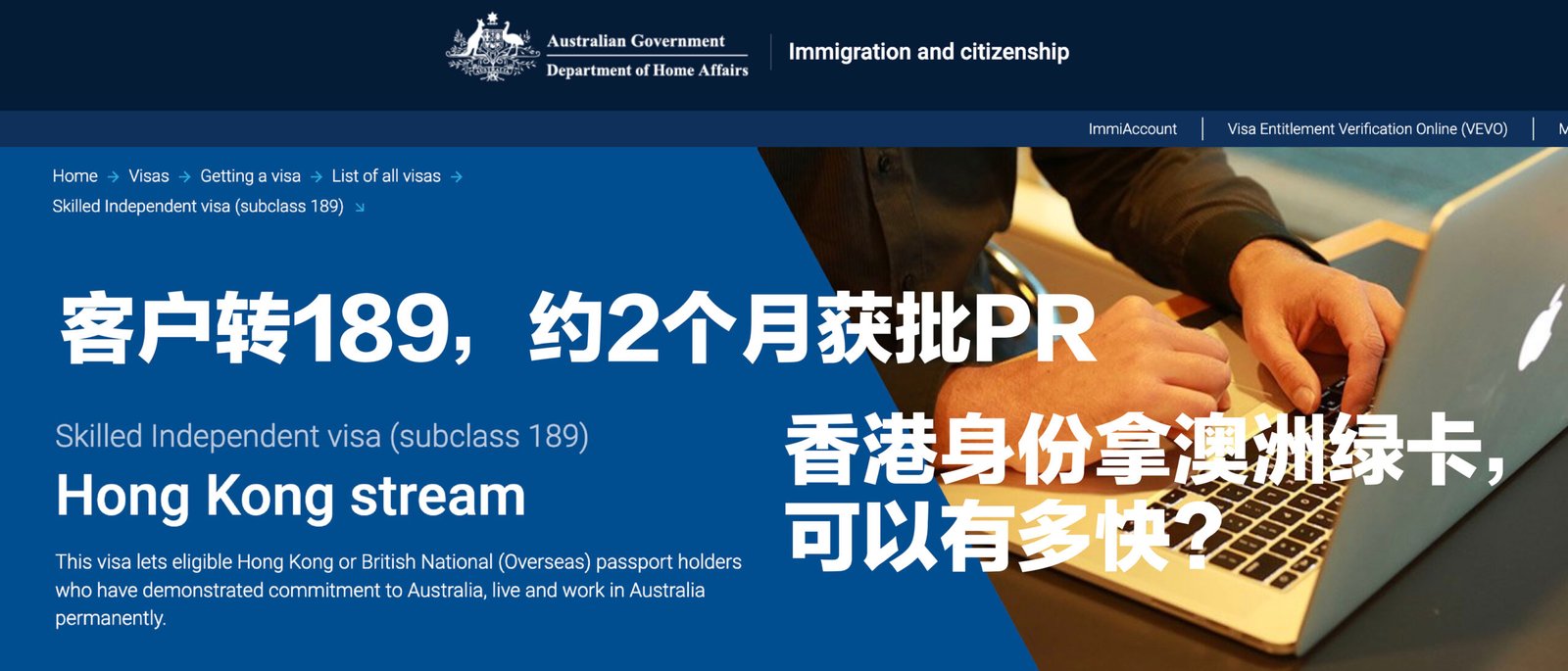
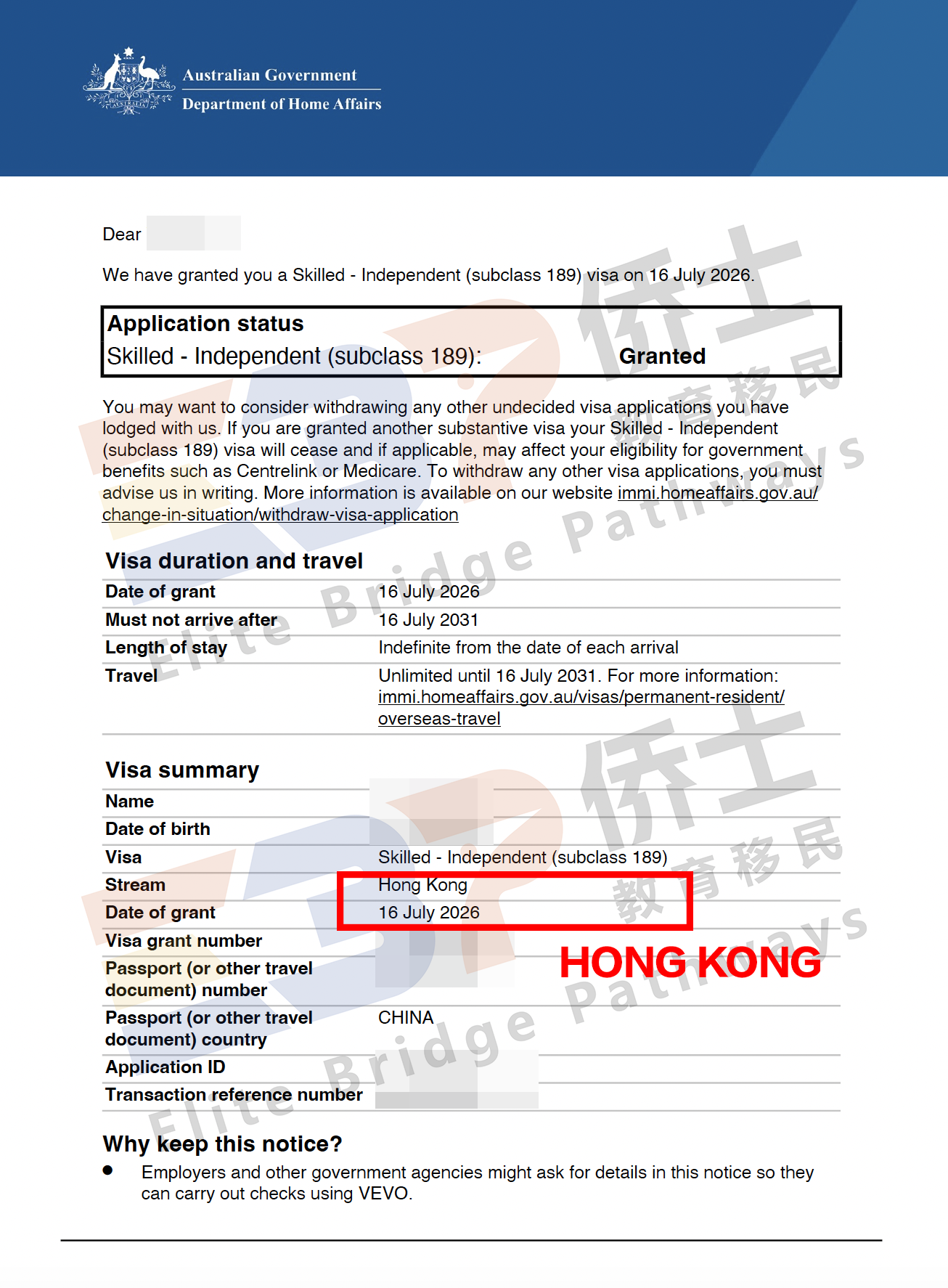
When it comes to Australian skilled migration, most people immediately think of a long checklist: skills assessment, English exams, EOI point scoring, waiting for state nomination, and lengthy invitation queues. However, the migration process is far more streamlined for holders of a Hong Kong Special Administrative Region (HKSAR) passport or British National (Overseas) (BNO) passport. Last month, one of our Hong Kong clients lodged an application for the Subclass 189 permanent resident visa. From formal lodgement to receiving PR approval, the entire process took roughly two months. This timeline is not guaranteed for every Subclass 189 application, yet this case clearly demonstrates that eligible applicants with fully prepared documentation can enjoy a straightforward permanent residency journey under the dedicated Hong Kong pathway.
Direct Access to Subclass 189 PR Once Residency Criteria Are Met永居
Our client held valid Hong Kong identity documents and passport, and resided in Australia on a qualifying temporary visa. Prior to lodgement, we completed thorough due diligence covering all core eligibility checks:
- Whether their passport meets the Hong Kong stream criteria
- Eligibility status of current and past Australian visas
- Compliance with the ordinary residence duration requirement in Australia
- Sufficient supporting documentation to verify residency history
- Satisfactory health, character and other mandatory visa requirements
- Any prior inbound/outbound travel records that may disrupt continuous residency
After confirming full eligibility, we assisted the client in compiling all supporting evidence covering residency, visa history, identity and personal background, then formally submitted the application under the **Subclass 189 Skilled Independent Visa – Hong Kong Stream**. The client was successfully granted Australian permanent residency in approximately two months, with no reliance on employer sponsorship or state government nomination.
Key Differences: Hong Kong Stream 189 vs Standard Points-Tested 189
Many applicants confuse all Subclass 189 visas with the mainstream points-tested independent skilled migration route. The standard Subclass 189 points-tested stream requires applicants to:
- Work in an eligible skilled occupation
- Complete a full vocational skills assessment
- Meet mandatory English proficiency benchmarks
- Accumulate sufficient migration points via age, education, work experience and other factors
- Submit an Expression of Interest (EOI) through SkillSelect
- Wait to receive an official invitation before lodging a visa application
By contrast, the Subclass 189 Hong Kong Stream operates as a standalone permanent residency pathway exclusively for eligible HKSAR and BNO passport holders. Applicants must hold a qualifying temporary visa and have maintained continuous ordinary residence in Australia for a minimum of four years immediately before lodgement. This stream prioritises three core criteria – passport status, valid qualifying visa and Australian residency history – rather than the competitive EOI points framework used for mainstream skilled migration. The Department of Home Affairs still administers the Subclass 189 Hong Kong Stream as a separate permanent visa category. The major advantage of this pathway is not automatic PR for all Hong Kong residents, but an alternative route that exempts qualifying applicants from competing for invitations via traditional points-based skilled migration.
Temporary Visas Eligible to Transition to Hong Kong Permanent Residency Pathways
Eligible HKSAR or BNO passport holders on certain Australian temporary visas may transition to either Subclass 189 or Subclass 191 permanent visas once they satisfy relevant residency rules. Common qualifying visa subclasses are outlined below:
485Subclass 485 Temporary Graduate Visa
For international graduates who complete an accredited Australian course, the 485 visa provides post-study work and residency rights. Under current Home Affairs policy, HKSAR and BNO passport holders may receive a maximum 5-year validity period for selected 485 visa streams. This creates a clear migration roadmap for Hong Kong students entering Australia: Australian studies → Subclass 485 graduate visa → Accumulate required residency years → Lodge Subclass 189 or 191 PR application
### Subclass 482 Temporary Skill Shortage Visa & Subclass 186 Employer Nomination Scheme (ENS) Visa
For candidates with relevant professional experience or a formal Australian employer nomination, the 482 visa serves as a common long-term residence pathway. Standard 482 visas carry a maximum 4-year validity, while eligible Hong Kong passport holders may qualify for up to 5 years on this visa. Applicants must secure a nomination from an approved sponsor and satisfy occupational skill, English and additional legislative criteria. A typical career migration plan includes: Australian employer nomination → Subclass 482 work visa → Build Australian residency tenure → Conduct individual assessment for Subclass 189 Hong Kong Stream, Subclass 191 Hong Kong Stream or Subclass 186 employer-sponsored PR
Subclass 189 for Metropolitan Residents, Subclass 191 for Regional Applicants
Two dedicated permanent visa streams are available exclusively for Hong Kong passport holders:
Subclass 189 Skilled Independent Visa – Hong Kong Stream: 4 Years’ Australian Ordinary Residence
This stream caters to applicants primarily residing in major metropolitan areas including Sydney, Melbourne and Brisbane, or those who fail to meet designated regional residency requirements. Applicants must demonstrate continuous ordinary residence in Australia for a minimum of four years immediately prior to lodging their application.
What Constitutes "Ordinary Residence"?
Assessment of ordinary residence extends far beyond the visa grant date. Case officers from the Department of Home Affairs evaluate multiple contextual factors holistically:
- Primary physical place of living
- Ownership or long-term rental accommodation in Australia
- Locations of employment and education
- Central hub of daily personal and social life
- Timing and duration of all inbound/outbound travel
- Genuine intention to establish Australia as a permanent home
Simply holding a qualifying visa for four years does not automatically satisfy this rule if the applicant spends extended periods overseas. The Department of Home Affairs has formal legislative requirements mandating four consecutive years of ordinary residence in Australia before Subclass 189 Hong Kong Stream lodgement.
Subclass 191 Permanent Residence (Skilled Regional) Visa – Hong Kong Stream: Regional Pathway
This stream is designed for Hong Kong applicants who live, work or study long-term within Australia’s designated regional zones. Eligibility hinges on fulfilling mandatory regional residency, employment or study criteria. It is critical to clarify that Australia’s migration definition of "regional areas" does not solely refer to remote rural towns; numerous large regional cities and surrounding zones fall under the designated regional classification for migration purposes.
Before selecting a university campus, workplace or relocating, applicants must verify whether the postcode meets the prevailing regional area policy requirements – eligibility cannot be judged by city names alone. The Department of Home Affairs continues to operate the Subclass 191 Hong Kong Stream for eligible Hong Kong applicants who maintain a sustained commitment to regional Australia.
Additional Australian PR Pathways for Hong Kong Residents
The dedicated Hong Kong visa streams are not the sole migration options available. Applicants may also evaluate mainstream skilled migration or employer sponsorship routes based on personal circumstances.
Mainstream Points-Based Skilled Migration
Available visa categories include:
- Subclass 189 Skilled Independent Visa (points-tested stream)
- Subclass 190 Skilled Nominated Visa (state-sponsored)
- Subclass 491 Skilled Work Regional (Provisional) Visa
All these streams mandate a vocational skills assessment, minimum age thresholds, English language requirements and a competitive points score, alongside an EOI submission via SkillSelect. Note that a score of 65 points only meets the minimum lodgement threshold and does not guarantee an invitation. Actual invitation cut-off scores and selection opportunities fluctuate based on nominated occupations, state migration policies, annual visa quotas and overall application volumes. Hong Kong residents therefore hold dual options: the Hong Kong dedicated residency pathways, or traditional points-tested skilled migration. The most suitable route depends on an applicant’s accumulated Australian residency tenure, occupation invitation prospects, availability of state nomination, and timeline for formalising permanent residency plans.
Employer-Sponsored Migration
Common visa subclasses:
- Subclass 482 Temporary Skill Shortage Visa
- Subclass 186 Employer Nomination Scheme Permanent Visa
- Regional employer sponsorship pathways leading to permanent residency
While Subclass 186 is a full permanent visa, it cannot be interpreted as a guaranteed direct PR pathway via securing any job offer. Both sponsoring employers and applicants must satisfy strict legislative benchmarks covering genuine position requirements, valid sponsorship accreditation, age limits, occupational competency, relevant work experience and English proficiency. The Subclass 186 Direct Entry Stream requires employer nomination, and primary applicants must generally be under 45 at lodgement unless a formal age exemption applies. Hong Kong applicants can plan both pathways concurrently. For example, a client currently on a 482 visa who has not yet accumulated four years’ residency for the Subclass 189 Hong Kong Stream can simultaneously assess whether the Subclass 186 route delivers faster PR approval.
Does Holding Hong Kong Identity Guarantee Fast Australian PR?
No. The Hong Kong dedicated streams provide a favourable policy framework but not unconditional permanent residency approval. All applicants must complete a full eligibility review covering:
- Document held: HKSAR passport, BNO passport, or Hong Kong Identity Card only
- Compliance of passport and identity documentation with official policy definitions
- Current Australian visa subclass
- Whether the visa qualifies for the Hong Kong stream pathways
- Total accumulated ordinary residence time within Australia
- Length of any extended overseas absences
- Place of residence: metropolitan or designated regional area
- Satisfactory health and character assessments
- Prior visa refusals, visa cancellations or complex migration history records
A critical clarification: holding solely a Hong Kong Identity Card does not automatically qualify applicants for the Hong Kong streams. Legislation prioritises valid HKSAR or BNO passports, paired with compliant temporary visas and verified residency history.
Recommended Next Steps for Hong Kong Residents Currently in Australia
Even applicants years away from meeting PR residency thresholds should avoid delaying preparation until they reach the minimum tenure requirement. We advise proactive advance planning with these five key steps:
1. Confirm eligibility for the Hong Kong dedicated visa streams
2. Collate complete Australian visa records and full travel entry/exit history from arrival in Australia
3. Retain comprehensive supporting evidence for rental accommodation, employment, education, tax filings and daily residency
4. If targeting the Subclass 191 regional stream, verify regional postcode eligibility prior to relocation, campus enrolment or job change
5. Compare the Hong Kong dedicated pathways, mainstream skilled migration and employer sponsorship routes – avoid over-reliance on a single migration strategy
Many applicants close to meeting Subclass 189 Hong Kong Stream criteria waste resources chasing extra EOI points via traditional skilled migration. Others mistakenly assume four years of visa validity alone satisfies all residency rules, overlooking passport requirements, qualifying visa classifications and the extensive supporting evidence needed to prove ordinary residence. Early eligibility audits and documentation preparation avoid costly, last-minute remedial work before visa lodgement.
Comment