




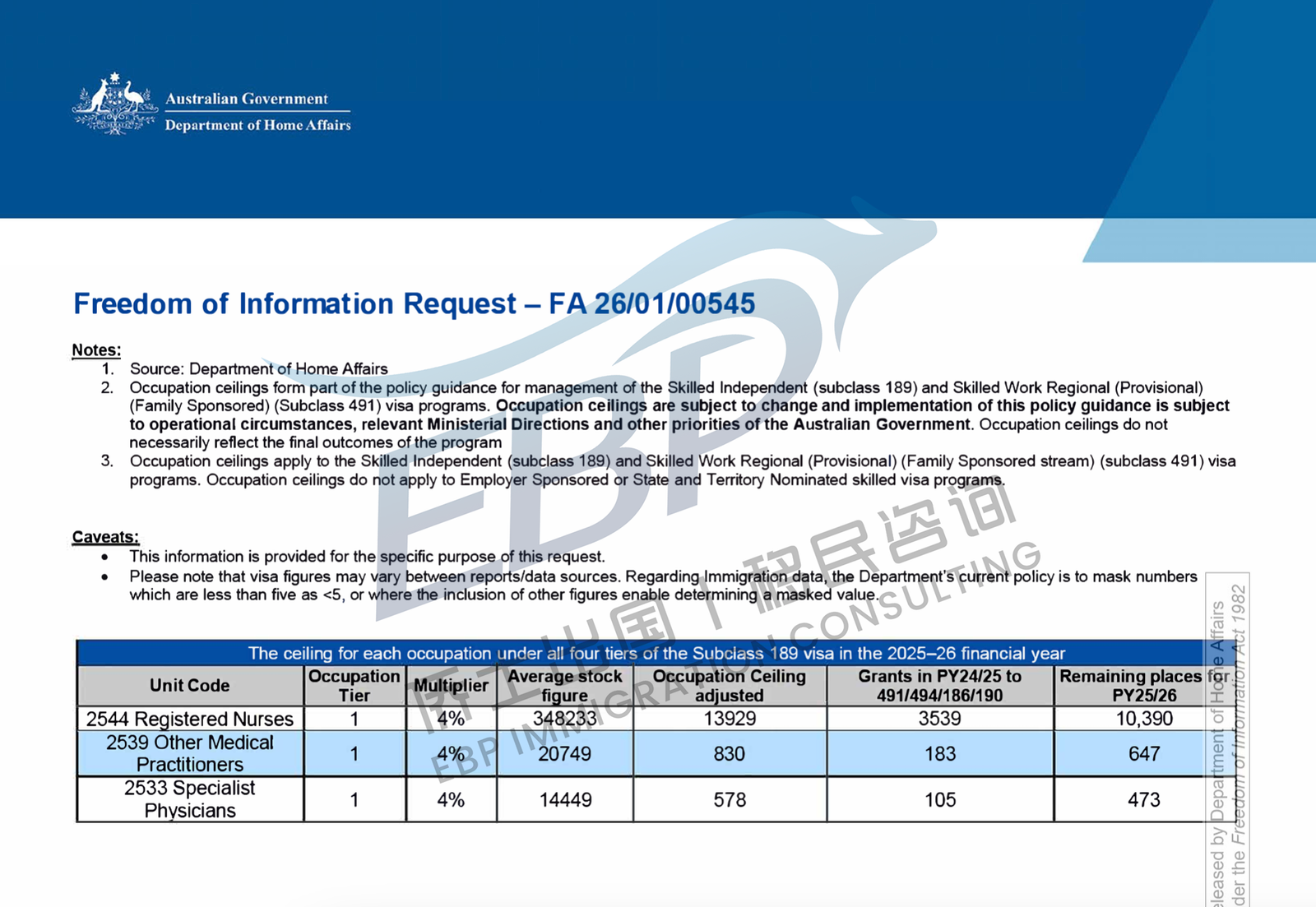
The Department of Home Affairs has officially released the 2025–26 Subclass 189 Skilled Independent visa occupation quota calculation model via FOI documents. This year’s quota is no longer a simple numerical allocation but an occupation ceiling mechanism based on workforce size, marking a shift toward more refined selection in skilled migration.
I. How Are 189 Quotas Calculated? (Understanding the Rules Matters More Than Numbers)
Quota Calculation Logic, Number of workers in the occupation × Tier ,Multiplier = Theoretical Ceiling.Theoretical Ceiling − Visas granted in the previous financial year = Invitation Ceiling for this financial year
Tier Levels & Multipliers
- Tier 1:4%
- Tier 2:2%
- Tier 3:1%
- Tier 4:0.5%
Key Rules, If the calculated result is below 500, the minimum floor of 500 applies. Remaining places are theoretical ceilings and do not guarantee invitations. If grants exceed the ceiling, no invitations will be issued for the occupation this financial year.
II. Health Occupations: The Biggest Winners This Financial Year
Nursing (ANZSCO 2544 Registered Nurses)
- Remaining quota:10,390
- Invitations issued: 3,500+
- Massive invitation space remains
Stable, year-round priority occupation
Other High-Demand Health Occupations (500+ places remaining)
Physiotherapists, Occupational Therapists, Audiologists / Speech Pathologists, Midwives, Medical Imaging Professionals,
Features:
- Low invitation volume to date
- Abundant remaining places
- Policy priority for workforce replenishment
One of the most stable 189 pathways in 2025–26
III. Education Occupations: A Critical Window for Student Migrant Pathways
Secondary School Teachers
- Remaining quota:2837
- Backlog far lower than Early Childhood Education
- Only 550+ invitations in the first two rounds
Early Childhood Teacher
- Remaining quota: 1,027
- Invitations issued: 600+
Social Workers
- Remaining quota: 876
IV. Trades Occupations: Continued Policy Support
Remaining quota:
- Electricians:1594
- Plumbers: 891
- Carpenters / Joiners: 908
Engineering Trades & Specialised Roles
- Civil Engineering Draftspersons: 130
Architects, Mining Engineers, Chemical Engineers:
200+ places remaining (cautious optimism)
V. Multiple Traditional Popular Occupations: No 189 Opportunities This Financial Year
Due to previous financial year grants exceeding theoretical ceilings, the following occupations have near-zero invitation chances in 2025–26:
Civil Engineers, Mechanical / Industrial Engineers, Electrical Engineers, Software Engineers / Programmers, ICT Business Analysts, Network Specialists, Accountants / Auditors, Motor Mechanics, Chefs
No invitations have been issued in the first two rounds, confirming the theoretical zero-invitation status. Key Signal: Australia’s skilled migration is shifting from traditional popular occupations to genuine labour shortage occupations.
VI. Overall 189 Trend Analysis
1.More cautious invitation volumes
Places exist, but distribution is far more targeted.
2. Quota tilt toward essential services
Healthcare, Education, Nursing, Trades
Summary
The 2025–26 Subclass 189 quota sends a clear policy message:
Migration is no longer about quantity, but genuine labour shortages, Essential service occupations receive top priority, Occupation choice determines migration success, The future of Australian skilled migration
It is not who has the highest points, but who is most needed.