




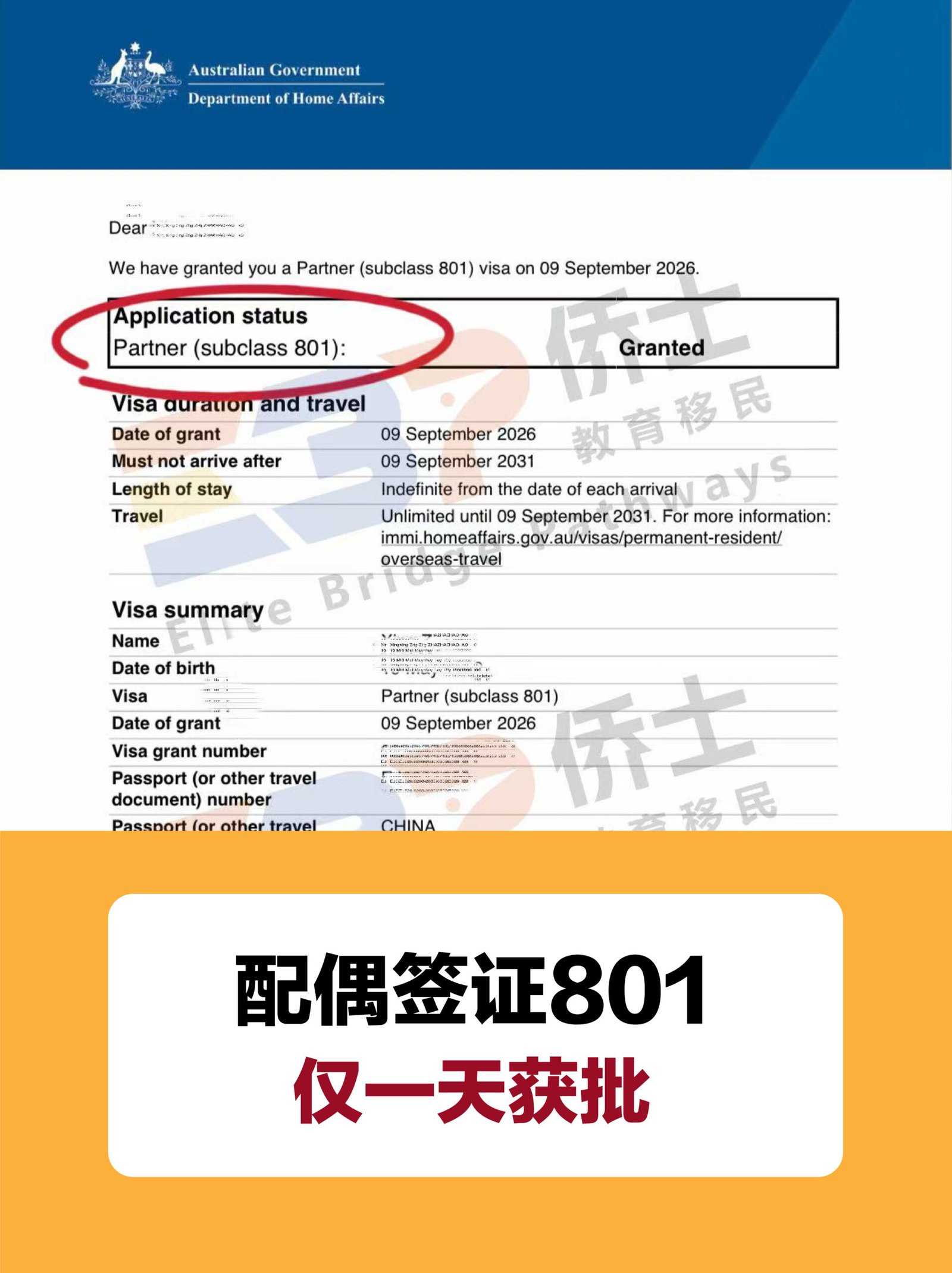
Who can relate to the joy of receiving this email! Just one day after lodging the Partner Visa 801 application, the grant notification arrived from the Department of Home Affairs. The freshly issued Grant Letter clearly states:
Partner (subclass 801) status:Granted
Congratulations to the applicant, who has officially obtained Australian permanent residency. From documenting every detail of their shared life to receiving this approval letter, the application journey has finally reached this reassuring milestone. Inspired by this approval case, let’s break down what Visa 801 is, when permanent residency assessment commences, and how to prepare relationship evidence.
- 801What does an 801 visa approval mean?
Visa 801 is the permanent stage of Australia’s onshore partner visa pathway. Once granted, the applicant holds Australian permanent residency and may live, work and study in Australia indefinitely. The commonly referenced “820 to 801 transition” describes moving from the temporary partner visa stage to the permanent partner visa stage.Important note: The “one-day approval” in this case refers to the processing time after lodging the 801-stage application, not the full 820/801 pathway. This application was supported by complete, genuine relationship evidence, leading to successful approval. Still, approval speed alone cannot reveal the exact reasons for the Department’s quick decision. Comprehensive document preparation does not guarantee the same fast processing outcome for every applicant.
- When can you proceed to 801 permanent residency assessment?
For applicants who first hold Visa 820 and then move to 801 assessment, permanent stage review generally begins two years from the **original date of lodgement** of the partner visa application. This two-year period is calculated from the initial application date, not the date the 820 visa was granted.Exceptions apply for long-term partner relationships and other qualifying scenarios, subject to individual eligibility assessment. Once entering the 801 stage, applicants must still submit required information and supporting documents. Reaching the two-year mark does **not** automatically grant permanent residency.For standard ongoing relationship applications, the core requirement is to demonstrate that the partner relationship remains genuine, continuing, and that shared life together has continued to develop. Special provisions apply if the relationship ends, the sponsor passes away, or domestic violence occurs; these situations require separate assessment.
- How to prepare relationship evidence? Organise materials around four core areas
When preparing 801 documents, verify that your evidence clearly demonstrates your shared life together across financial arrangements, household life, social recognition and long-term commitment.
1. Financial ties: How do you share living expenses?
Documents you may compile:
- Joint bank account statements showing transactions used for household living costs
- Payment records for rent, mortgage, utilities, internet and other shared bills
- Transfer records between one another for daily living expenses
- Proof of jointly held assets, loans or other financial liabilities (where applicable)
Add brief notes explaining how expenses are split. For example, if one party pays rent while the other covers groceries and utility bills, match your written explanation to the corresponding records. If you maintain separate bank accounts, truthfully explain your financial arrangement and provide evidence showing shared responsibility for household costs.
2.Household life: How do you live together as a couple?Household life: How do you live as a couple?
Consider including:
- Joint lease agreements, lease renewal records, or documents relating to jointly owned property
- Official correspondence addressed to the same residential address, naming both parties separately
- Statements outlining household division of labour and daily living arrangements
- Records of shared childcare responsibilities, if you have children
For the 801 stage, focus on changes occurring after your previous submission: relocations, lease renewals, property purchases or changes to family composition. If you live apart temporarily due to work or study, explain the duration and reasons for separation, and provide evidence showing how you maintained your relationship during this period.
3.Social recognition: Do family and friends recognise your partnership?
Consider including:
- Photographs taken at events attended together with family and friends
- Joint event invitations and records of shared attendance
- Flight tickets, accommodation bookings and itineraries for trips taken together
- Supporting statements from witnesses who know your relationship
Label photos with date, location, people present and event context to help case officers understand the scene. If submitting Form 888, the referee must be aged 18 or over, have knowledge of you, your partner and your relationship history, and provide identification as required on the form. Use the latest version published by Home Affairs, and follow the checklist or request regarding the number of forms required. Witness statements should describe how they know you both, the nature of their contact with you, and their personal observations supporting the genuine and ongoing nature of your relationship.
4.Long-term commitment: How do you support one another and plan for the future?
Documents you may compile:
- Individual statements from both of you describing the ongoing development of your relationship
- Specific examples of mutual support during work, study, health or family hardships
- Communication records and visit arrangements during periods of temporary separation
- Written account of shared living arrangements and other future plans
- Insurance, superannuation beneficiary nominations or wills (where applicable)
Write your relationship statements in your own voice, based on real experiences. For instance, describe recent shared milestones, life changes and joint decisions you have made. Specific, consistent personal accounts carry more weight than polished generic templates.
4.Beyond relationship evidence: What other documents should you check?
As you enter the 801 stage, review the following items to confirm what needs to be submitted or updated:
- Identity documents: Updated passports, and any changes to name, residential address or contact details
- Relationship or family change documents: Marriage certificates, name change documents, child birth certificates (where relevant)
- Applicant and sponsor declarations: Complete required forms or statutory declarations per your ImmiAccount checklist, verifying signatures, dates and witness requirements
- Character and health documents: Check whether new police clearances, supplementary information or medical examinations are required
- Non-English documents: Comply with translation requirements, supplying original documents alongside certified translations
- Requested additional information: Confirm any outstanding requests and their corresponding deadlines
Avoid copying document checklists from other applicants. The Department of Home Affairs advises applicants to follow the checklist inside ImmiAccount and the lodgement guidance on the relevant visa webpage.
- Three final checks before lodgement
1. Review your timeline. All dates in your statements — meeting, commencing the relationship, cohabitation, marriage, relocation — must align with supporting evidence. Clearly explain any periods requiring clarification.
2. Ensure evidence reflects your recent life. While the 801 submission may reference the start of your relationship, materials must demonstrate how your partnership continued after your earlier application.
3. Verify document readability. Group files by category and date, use clear file names, and ensure full, legible scans. Add brief explanatory notes for transfers, photos or travel records that require context.
A well-prepared application allows case officers to easily understand how you live as a couple and how your relationship has endured to the present day.
Comment