





If you hold a nursing qualification and relevant work experience from China and intend to migrate to Australia, you may explore a combined strategy covering skilled migration and employer nomination streams — what we refer to as the nursing migration dual-track plan. Please note that this dual-track framework is a personalised planning approach, not a fixed migration programme released by the Australian Government. Both pathways may not be suitable for every individual, and eligibility must be assessed against your personal circumstances on a case-by-case basis.
Australian nursing migration falls into three main occupational categories: Registered Nurse, Enrolled Nurse, and Nursing Support / Aged Care Worker. Each category has distinct requirements for qualifications, practice history and job duties. Chinese academic qualifications cannot be directly mapped to Australian occupations by education level alone. During assessment, we will review your age, full academic documentation, curriculum and placement records, Chinese nursing registration status, clinical employment history across all roles, payslips and social security records, English test results, alongside your budget and preferred work locations. We will outline your existing eligibility, gaps to fill and documentation requirements, and will not simply give a definitive “approved for migration” or “ineligible” outcome.
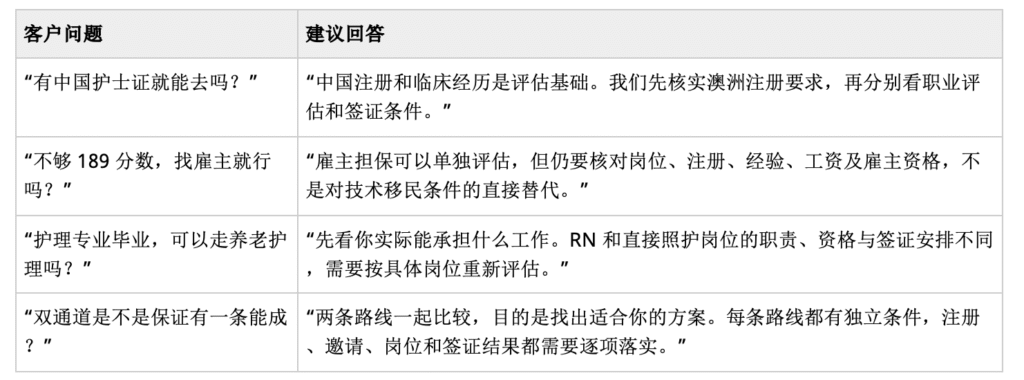
Australian nursing migration consists of three separate, non-interchangeable critical stages: nursing registration, migration skills assessment, and visa application. A Chinese nursing practising certificate does not automatically grant Australian nursing registration; passing registration examinations does not equal successful Australian registration. A positive nursing registration outcome also does not guarantee a favourable migration skills assessment. Even with a successful skills assessment, there is no guarantee of receiving an invitation to apply or visa grant.
Overseas nurses applying for Australian nursing registration are allocated different pathways based on their qualifications and credentials. Some applicants will need supplementary assessment, examinations or bridging courses. Not all Chinese nursing backgrounds qualify for streamlined pathways, nor is an Australian Bachelor of Nursing a mandatory requirement for everyone. English requirements are purpose-specific: separate score benchmarks apply for nursing registration, migration skills assessment, baseline visa criteria and skilled migration points testing. These standards cannot be cross-used, and regulatory English requirements are subject to periodic updates by Australian authorities, with the rules in force at the time of application applying.
Migration skills assessments are conducted by ANMAC under different assessment streams. ANMAC reviews overseas registration, academic qualifications, core clinical duties and relevant work history. Whether work experience is acceptable for skills assessment and whether the same experience can contribute points for skilled migration follow separate criteria. Not all years of employment count towards migration points, and assessment outcomes carry an expiry date. You must confirm your assessment remains valid at the time of invitation and visa lodgement.
For skilled migration, the available visa subclasses include Subclass 189 Independent Skilled Visa, Subclass 190 State Nominated Visa and Subclass 491 Regional Provisional Visa. Invitations are points-based; 65 points is only the minimum threshold, and meeting this score does not guarantee an invitation. The 491 is a provisional visa with additional requirements to be met before permanent residency can be obtained; it does not automatically convert to permanent residence.
The employer nomination stream covers visas such as Subclass 482 Temporary Skill Shortage Visa and Subclass 186 Employer Nomination Scheme Permanent Visa. A compliant Australian employer and a matched role are required, alongside mandatory nursing registration, relevant work experience and English proficiency. Employer nomination is not a simple fallback option for applicants who fall short on skilled migration points. Nursing support roles in aged care may be covered under a separate labour agreement, which carries different migration entitlements and role requirements from Registered Nurse pathways and requires dedicated assessment against agreement terms.Periodic invitation rounds for nursing occupations are reported publicly. Outcomes from one invitation round do not represent equal prospects for all nursing applicants, nor do they guarantee identical criteria for future rounds. We make no invitation guarantees based on past invitation trends.
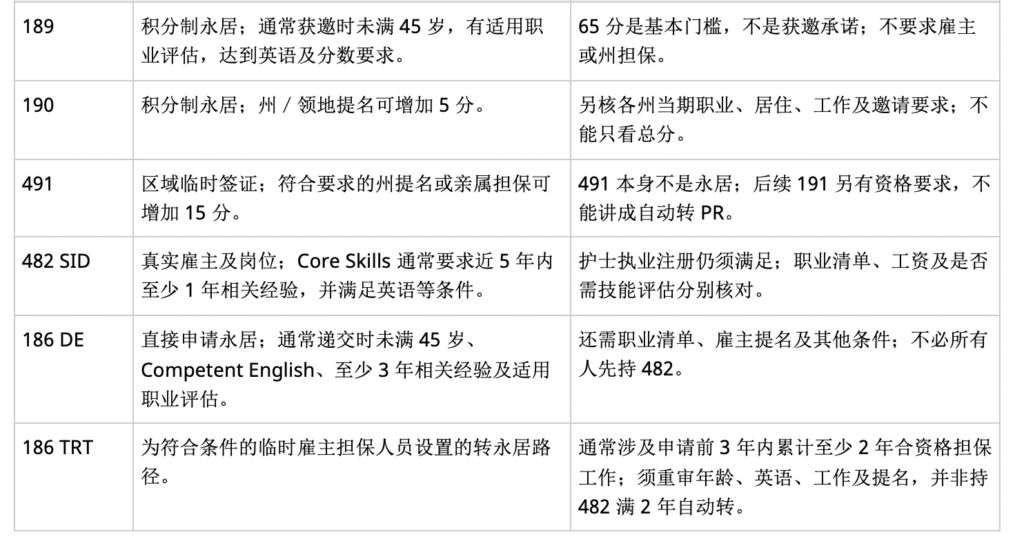
We will complete an occupational mapping exercise after reviewing your full supporting documentation, clarify registration requirements and English gaps, match you to the correct ANMAC assessment stream, calculate your skilled migration points and evaluate the practical viability of employer nomination. This process identifies your primary pathway and backup options, lists supporting evidence to prepare, and sets timelines for reassessment. Registration vetting, skills assessment results, invitation prospects, employer availability and visa decisions vary widely between applicants. All plans are subject to Australian legislation and policy in force at the relevant time, as well as your genuine personal credentials.
Comment