




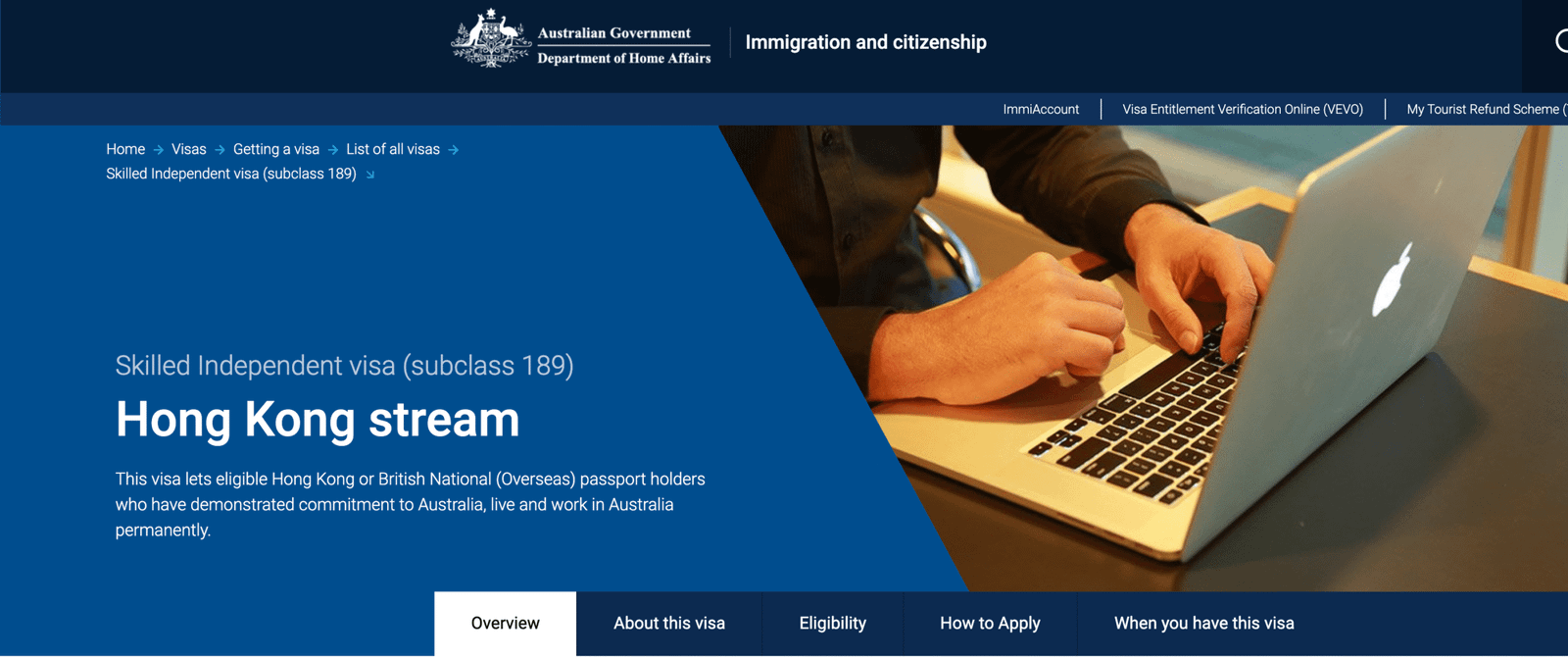
Once you meet the passport criteria, your visa history and ordinary residence requirements become equally critical. What if you did not need to keep boosting your EOI points for the 189 stream, or wait for your occupation to be invited in the next round? Would your migration planning become much simpler? For eligible holders of Hong Kong passports or British National (Overseas) passports, the 189 Hong Kong stream offers exactly this alternative pathway.
Commonly referred to as “HK189”, this is a dedicated stream under the Subclass 189 visa. It does not adopt the EOI competition and invitation mechanism used for the standard points-tested 189 stream. At the permanent residency application stage, applicants are not assessed against the same nominated occupation, skills assessment and points criteria. Unlike the mainstream points-based 189 route, this stream has no 45-year age cap.This is its most compelling advantage: for candidates who satisfy the entry prerequisites, planning can focus on securing qualifying temporary visas, meeting residence rules and compiling supporting documentation. Still, removing points competition does not remove application requirements. In particular, the two core requirements — holding a qualifying Hong Kong passport and completing four years of residence — cannot be oversimplified.
First, eligibility for the passport. The key requirement is a valid Hong Kong Special Administrative Region passport or BNO passport that meets the legislative criteria. Holding a Hong Kong identity card alone is insufficient. Obtaining Hong Kong residency via the Top Talent Pass Scheme, Quality Migrant Admission Scheme, employment or study does not automatically grant you a HKSAR passport. The Immigration Department of Hong Kong sets separate requirements for HKSAR passport applications, including Chinese nationality, the right of abode in Hong Kong and a valid Hong Kong Permanent Identity Card. For those planning to obtain Hong Kong residency first before applying for Australian migration, this passport eligibility journey must be calculated separately. The well-known seven-year ordinary residence route also needs to satisfy substantive criteria; holding identity documents for seven years does not guarantee passport issuance.
Therefore, if you already hold a qualifying passport, your next step is to map out your Australian visa pathway. If you have only recently been approved for a Hong Kong residency scheme, you need to clarify what further criteria you must satisfy before becoming eligible for the required passport. These two groups face different time costs, living arrangements and policy change risks.
Next, the Australian visa requirements. The Hong Kong 189 stream is not simply a pathway where you arrive in Australia on your passport and apply after four years of stay. Departmental rules state that at the time of application you must hold a qualifying visa: Subclass 457, 482 or 485, approved based on you meeting primary applicant criteria. If you were granted your visa as a secondary applicant (e.g. spouse), you cannot rely solely on the visa subclass number to lodge as the primary applicant under this stream.You also need to verify the prescribed validity arrangements for your visa. For visas granted on or after 9 July 2020, relevant legislation requires a five-year travel and stay entitlement from the date of grant. Transitional provisions apply to older visas. You cannot assume eligibility merely because you hold a 482 or 485 visa.
The four-year requirement is split into two separate timelines: the period you hold a qualifying visa, and proof of ordinary residence in Australia for at least four consecutive years before application. Holding a visa for four years does not automatically prove you have satisfied residence rules; living in Australia for four years does not mean you have met the visa criteria either.
This is a detail that frequently derails planning: official guidance confirms that periods held across multiple visas, even within the same visa subclass, cannot simply be added together to satisfy the four-year qualifying visa requirement. For example, holding a 485 for two years then switching to a 482 for another two years does not let you sum the two periods and lodge immediately. The exact start date must be assessed against the grant terms of each individual visa. This explains why a timeline review is essential before changing visas. Changing employers or nomination arrangements may trigger a new visa application, and you need to understand how the new visa will impact your future application date, rather than only looking at the validity period you receive now.
Ordinary residence is not just about entry and exit stamps. The Department considers where your actual home is and whether Australia is your primary place of living. Short overseas trips do not automatically disqualify you. However, long-term work and residence outside Australia with only occasional visits back must be carefully assessed on individual facts. There is no universal, verified formula such as “X days per year guarantees compliance” that you can blindly follow.For applicants who already hold a qualifying passport, there are two common entry routes to evaluate.The first pathway is to complete an eligible Australian course, then obtain the corresponding graduate visa once 485 criteria are met. Eligible HKSAR or BNO passport holders may access the five-year 485 arrangement, though age, course, English and visa history requirements still need to be checked item by item. The five-year validity provides planning flexibility; it does not equate to automatic visa approval.
The second pathway is to apply for a work visa such as 482 based on genuine employment once you meet the criteria. The fact that the HK189 permanent residency stage does not require a separate 186 nomination from your employer does not mean you can disregard nomination, role and visa conditions during your 482 phase. Your employment arrangements while holding the temporary visa must continue to comply with your visa obligations.
For those already in Australia on relevant visas, the practical starting point is a full document audit: confirm passport eligibility; check the grant date of your current visa and whether you were approved as primary or secondary applicant; review any prior visa changes; gather immigration travel records for the past four years; and list evidence to support your ordinary residence. Only after sorting out these details can you confirm your earliest possible application date. Residence evidence should be collected continuously during your stay. Rental agreements, address updates, employment and tax records, regular bank statements, study or family documents can all help substantiate your genuine residence. The key is that different documents align to the same period of life. Trying to source all these records retroactively after four years is far more difficult than preserving them as you go.
English proficiency cannot be dismissed entirely. This stream requires Functional English, and the second instalment visa charge may apply. Adult family members must also be assessed individually. Health, character and compliance with visa conditions are standard requirements for the application.
If you plan to bring your spouse or children, family member eligibility, relationship evidence and individual criteria need separate assessment. The primary applicant holding a qualifying passport does not waive requirements for other family members. Household income, living costs and children’s arrangements during your stay in Australia should also be considered for the whole family.
In my view, HK189 is best suited for candidates who already have a qualifying passport, intend to make Australia their main place of residence, and can obtain and maintain a qualifying temporary visa. Its benefits are substantial, but they rest on being able to satisfy entry, visa holding and residence obligations. If you are exploring this pathway, prepare your passport, past Australian visa grant notices and travel records. Rather than only asking “how attractive is HK189”, it is more valuable to verify: from which date you will meet the criteria, and which future decisions will alter your timeline. Building a solid four-year visa and residence plan is how you turn this policy advantage into a viable migration pathway.
Comment