




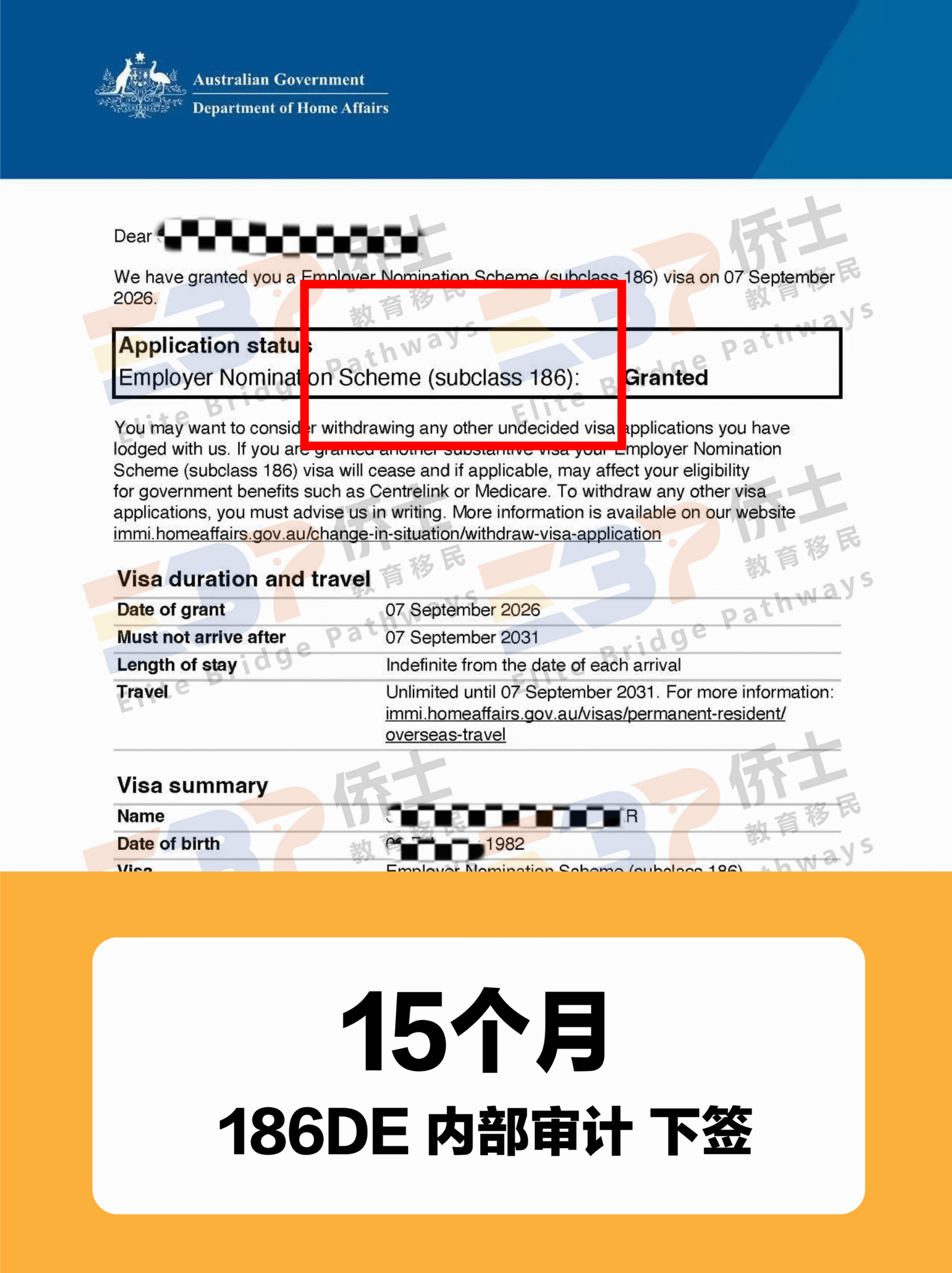
A 186 Direct Entry application lodged onshore was approved after approximately 15 months. When seeing outcomes like this, applicants waiting for permanent residency often have two pressing questions: Can I take this pathway? Will my application also take this long? My advice is to focus on the first question. The 15-month processing time applies only to this individual case and cannot be used to estimate timelines for all applications. For those still planning their migration journey, what truly merits careful review is whether you meet the requirements to apply directly for permanent residency, and whether the position offered by your employer can withstand departmental scrutiny.
In 186 DE, DE stands for Direct Entry. This is an employer-nominated permanent residency stream. It does **not** require all applicants to first hold a 482 visa and work for the same employer for two years as a prerequisite. This is particularly valuable for applicants who already have relevant professional experience, can obtain a suitable skills assessment, and hold a genuine Australian job offer. Whether you need to apply for a 482 visa first should be determined based on your current eligibility and employment arrangements. Precisely because this stream leads straight to permanent residency, you should not treat “having an employer willing to nominate you” as meaning your application is half successful. A 186 DE application must address two sets of questions: why the business needs this role, and why you are qualified to fill it. Employer nomination and the personal visa application are two separate components that each need to satisfy their respective criteria.
First, the applicant. Generally, you must be under 45 at the time of lodgement, hold competent English, obtain a valid and relevant skills assessment, and have at least three years of full-time work experience at the skill level of the nominated occupation. Statutory exemptions are assessed on a case-by-case basis. Your occupation must also fall within the eligible occupation list for 186 DE and comply with associated restrictions. For regulated professions requiring licences or registration, relevant requirements must also be verified. You and any family members included must meet health and character requirements.The three-year work experience requirement is frequently underestimated. Listing three years on your resume does not guarantee all of that experience will be recognised. Similar job titles do not mean the duties and skill level of the roles are equivalent. Internships, support-level work and roles that do not meet the required skill threshold are assessed based on individual facts. Employment start and end dates, actual duties, working hours, payroll records and employer statements must be consistent and corroborate each other.Skills assessment and visa work experience requirements are separate matters. Receiving a positive skills assessment does not mean the Department of Home Affairs has already confirmed you satisfy the full three-year experience requirement for 186 DE. Conversely, you cannot mechanically apply the experience deduction outcomes used by assessing authorities for points-tested migration as the sole method to calculate experience for a 186 DE application. Assessment body rules, actual job duties and visa criteria must all be reviewed together.
Next, the employer. The business must operate genuinely, have a genuine need for the position, and be able to offer a permanent, ongoing full-time role that meets visa standards. The nomination must support a minimum two-year employment arrangement, alongside proof of the business’s capacity to employ and pay the nominated worker. Commitments written into an employment contract need to be backed by the business’s operational evidence.
For example, if a company is expanding and intends to create a new professional role, client contracts, ongoing projects, existing staff allocation, financial records and projected workload should justify this new position. There is no need to present every business as a large corporation. What matters more is that the company’s size, business stage, role duties and remuneration package are logically consistent.When considering salary, do not only focus on the minimum threshold. In standard cases requiring market rate and income threshold compliance, the business must demonstrate the typical remuneration paid to Australian workers in the same region for comparable roles and qualifications, explain why the proposed salary is reasonable, and confirm the business can sustain the payments. Following the 1 July 2026 adjustments, the relevant Core Skills Income Threshold is AUD 79,423. However, merely meeting this figure does not replace the requirement to demonstrate market rate alignment.
Hypothetical example: If the reasonable market annual salary for a role is around AUD 100,000, setting the contract salary just above the migration threshold will still trigger scrutiny on market rate. On the other hand, if a business has limited scale and turnover yet offers a high salary contract unsupported by its operations, additional explanations will be required. Remuneration must stem from a genuine employment decision.One common point of confusion between 186 DE and the 482 visa: the formal LMT advertising rules applicable to 482 visas cannot be directly adopted as universal lodgement requirements for 186 DE. That said, the genuine need for the role still needs to be proven. Recruitment history can serve as supporting evidence; business documentation, staff duty allocation and long-term staffing needs are equally important.
Being physically present in Australia does not mean everyone can lodge an onshore application directly. Your current visa, attached conditions, and any prior visa refusals or cancellations may affect your available application pathways. Employer submission of a nomination does not grant the employee new stay or work rights. Visa transition arrangements need to be planned independently and should not be left until your current visa is close to expiry. Once an application is under processing, the continued existence of the position and ongoing employer support for the nomination remain relevant to the outcome. The visa criteria for 186 DE require the nomination to remain approved and not withdrawn, with the role still available to you. If you apply for the visa after securing nomination approval, note that visa lodgement generally must occur within six months of nomination approval.
Therefore, when preparing a 186 DE application, I recommend completing three concrete preliminary tasks: thoroughly verify your relevant work history; ask your employer to compile documents proving the role and payroll capacity; and map your English proficiency, skills assessment validity and current visa timeline in one schedule. After identifying gaps, you can decide whether to gather further evidence, adjust your timeline, or consider alternative transitional arrangements.While this 15-month approval case is worth sharing, its most useful takeaway for other applicants is to recheck your eligibility for direct permanent residency application. If you hold relevant occupational experience and have an employer willing to offer long-term employment, you may submit your resume, skills assessment and position details for a comprehensive assessment. Clarify upfront whether you are eligible to lodge, what gaps exist and how to address them, so every subsequent step can be taken with greater certainty.
Comment