




Recently, several key updates regarding Australian immigration and visa processing have drawn significant attention from applicants. According to information released at the March 2026 quarterly meeting between MIA and the Department of Home Affairs, visa processing across skilled migration, student visas, bridging visas and employer-sponsored visas shares a common trend: stricter assessment, slower processing, and a greater need for advanced planning. For those preparing applications for the 189 visa, student visas, BVB or employer-sponsored visas, the following changes are particularly important.
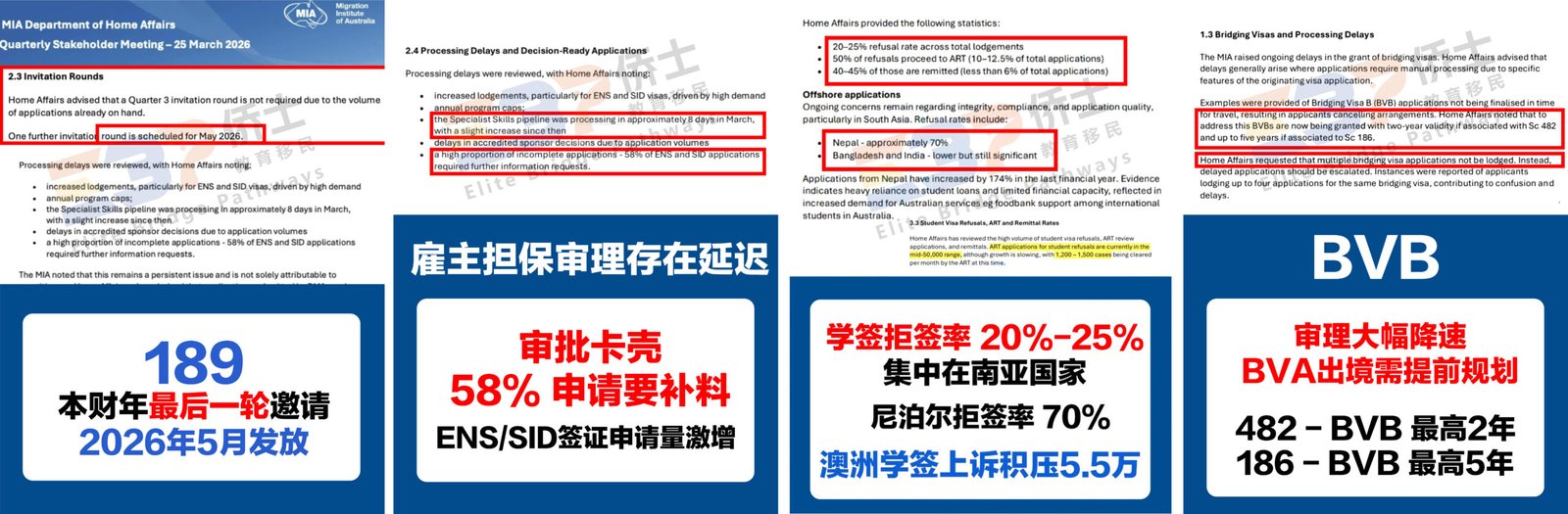
1. Changes to 189 Invitation Rounds: No March Round; May Expected as Final Round for the Financial Year
The meeting confirmed that no 189 invitation rounds will be held in Q3 of the 2025–26 financial year (January–March). As a result, many applicants hoping for an invitation in March will face further delays. Current information indicates that the final 189 invitation round for this financial year is expected to be released in May 2026.The main reasons for cancelling the planned March round are:
A large number of invitations were issued in November 2025;
The annual quota has been exhausted early;
Therefore, the originally planned March round has been reduced or cancelled entirely.
In terms of quota usage:The total 189 quota for 2025–26 is 16,900 places.As of March, two rounds have been held, issuing a total of 16,887 invitations.This means only a very small number of places remain, and the May round will almost certainly be the final round of the financial year. For applicants waiting for a 189 invitation, competition will become even more concentrated. Points, nominated occupation and timing of application will all become more critical.
2. Higher Student Visa Risks: Overall Refusal Rate at 20%–25%.Conditions for student visas have also become increasingly challenging.Meeting data shows the overall student visa refusal rate is approximately 20%–25%, reflecting tightened scrutiny, especially regarding:
Genuine temporary entrant (GTE) intention; Financial capacity; Study purpose; Completeness of documentation.Around 50% of refused applications go to the Administrative Appeals Tribunal (AAT); This represents approximately 10%–12.5% of total applications; Around 40%–45% of these appealed cases are remitted for reconsideration; Ultimately, remitted cases account for less than 6% of total applications.
These figures highlight two key points: Student visa refusals are common under the current strict environment, not isolated incidents. Even if an appeal is lodged, success is not guaranteed, with long waiting times and high uncertainty. By nationality: Refusal rate for Nepalese applicants is approximately 70%, making them a high-risk group; Bangladesh and India also show high refusal rates, albeit slightly lower. For prospective student visa applicants, the priority is not rushing to apply, but ensuring: Complete and logical documentation, Adequate and well-explained funds, Clear and consistent genuine study intention. Under strict processing, poorly prepared applications carry increasingly high risks.
3. Significant Delays in BVB Processing: Apply at Least 4–6 Weeks Before Travel
Many temporary visa holders are directly affected by slower processing for Bridging Visa B (BVB).Due to a surge in applications and constrained processing resources, BVB approvals have been noticeably delayed. For anyone needing to travel overseas on a BVB, the most practical advice is:Submit your BVB application at least 4–6 weeks in advance.Failure to do so may disrupt travel plans if the visa is not approved before departure. The Department of Home Affairs also clearly stated:Repeated applications to “speed up” or “jump the queue” are not recommended and will not be accepted.In case of delays, applicants should follow standard procedures and use escalation or communication channels if needed, rather than lodging duplicate applications.
A positive policy update: BVB linked to 482 visas may be granted with 2-year validity; BVB linked to 186 visas may be granted up to 5-year validity.
This reduces the need for frequent renewals, but early planning and lodgement remain essential.This reduces the need for frequent renewals, but early planning and lodgement remain essential.尽早规划,尽早递交。
4. Slower Employer-Sponsored Visa Processing: ENS & SID Particularly Affected
Employer-sponsored visa processing is also experiencing delays, especially for ENS and SID.The meeting noted that a sharp rise in applications combined with annual visa caps has slowed overall processing. As of March 2026, the processing time for Specialist Skills was around 8 days, but has since begun to increase.Even faster-stream categories are now affected by overall application pressure. A major issue is the high rate of incomplete applications:Approximately 58% of ENS and SID applications require further documentation.This means many delays are not only due to queuing, but also gaps at the time of lodgement, leading to requests for additional information and longer processing.
For employer-sponsored visa applicants, key considerations now include:
Ensuring all documents are complete in the first lodgement;
Full and correct employer documentation;
Consistent evidence of genuine position, salary and business need;
Allowing sufficient buffer time for processing and potential requests.
In the coming period, success in employer-sponsored visas will depend not only on eligibility, but also on document quality and application strategy.
5. How to Respond to the Current Environment
Overall, the meeting signals that Australia’s visa system has entered a more cautious phase with stronger quality control.For all visa types, a core principle applies:The old “apply first and sort details later” approach is no longer suitable.
More reliable strategies:
Skilled migration applicants: Assess points and round timings early; manage expectations for the potential final 189 round in May.
Student visa applicants: Focus on document quality, financial credibility and genuine temporary intention.
Bridging visa holders travelling overseas: Prepare BVB at least 4–6 weeks in advance.
Employer-sponsored applicants: Minimise requests for further information and avoid avoidable processing delays.