




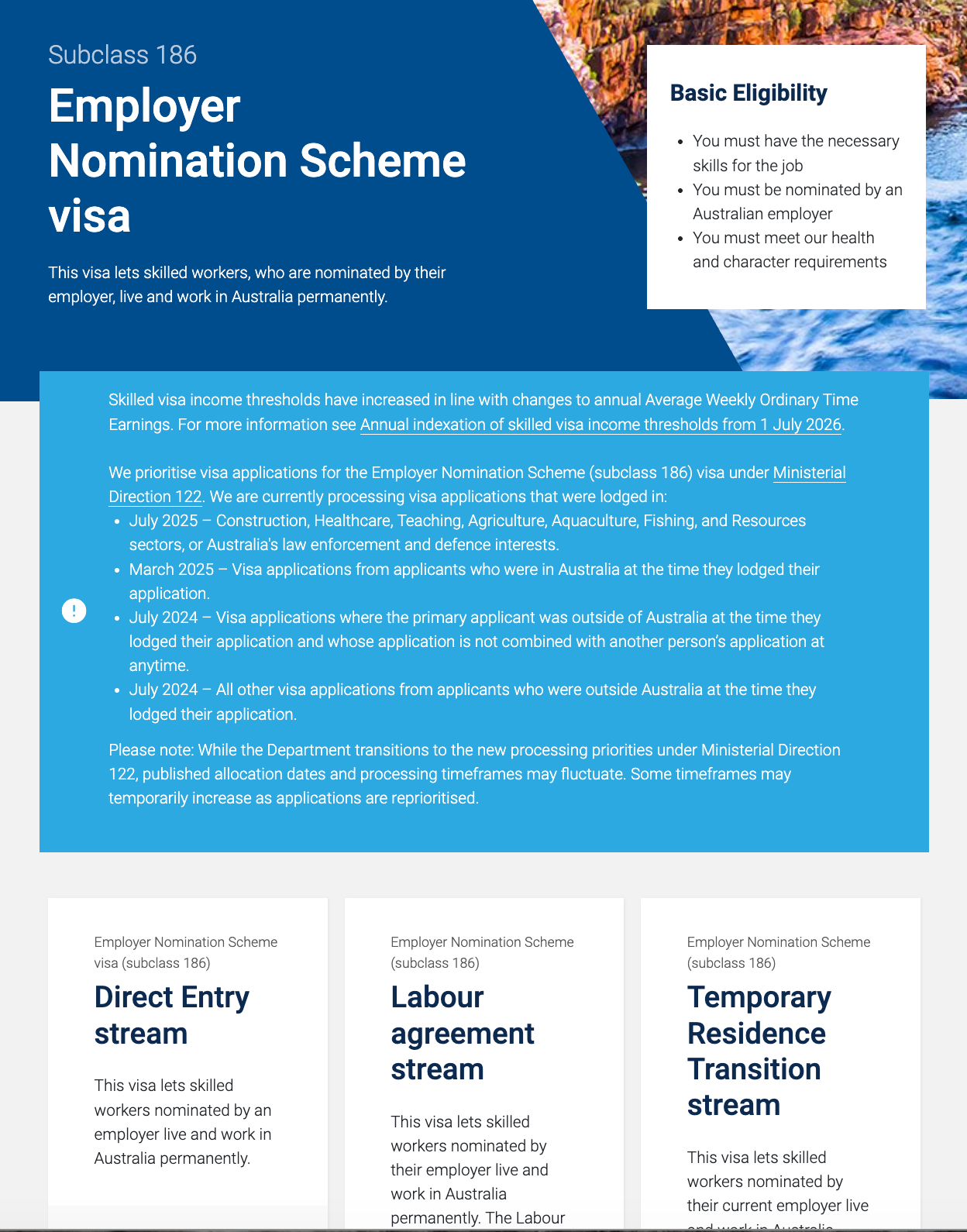
Rule review date: 26 October 2026 | This article applies only to the 186 Temporary Residence Transition (TRT) stream. Rules for Direct Entry and Labour Agreement streams do not apply.
Grant of a 482 employer‑sponsored visa only grants temporary work rights under sponsorship in Australia. It does not guarantee automatic grant of 186 permanent residency after two years.For applicants following the 186‑TRT pathway, there is no general answer as to whether accumulated qualifying working periods will be reset upon changing employers or roles. Visa, sponsorship and actual employment records must be assessed on a case‑by‑case basis.
Two‑year Requirement under 186‑TRT: Visa Holding Period and Qualifying Employment Are Calculated Separately
Under Australia’s *Migration Regulations 1994*, two sets of core timing requirements apply to the TRT stream and must be satisfied independently. One cannot substitute the other.
- 1. Within the rolling three‑year period prior to lodgement of the 186 application, hold a valid 457, 482 or eligible bridging visa for a cumulative period of at least two years.
- 2. Within the same three‑year window, complete at least two years of full‑time qualifying employment in the nominated occupation for an approved sponsoring employer.
Key Notes
- Holding a 482 visa for two years does not equate to completing two years of qualifying employment. Periods of unemployment, non‑commencement of employment and unpaid leave are excluded from qualifying working time.
- The three‑year window rolls backward from the 186 application lodgement date. Previously qualifying employment will not count if it falls outside this timeframe. Assessment is based on the intended lodgement date for permanent residency, not the date of 482 visa grant.
- Bridging visas do not automatically count towards qualifying periods. Consideration must be given to the preceding substantive visa, the basis of the bridging visa and actual work arrangements.
Changing Employers: Prior Qualifying Employment May Be Counted Cumulatively, Subject to Conditions
xisting policy does not automatically invalidate prior qualifying employment when an applicant changes employers. Qualifying periods completed with different approved sponsoring employers may be combined.
Simplified example: An applicant completes 16 months of qualifying sponsored employment with Employer A, then lawfully transfers to Employer B for a further 8 months. Where both periods fall within the three‑year pre‑lodgement window and all visa, sponsorship and role requirements are met, these periods may be aggregated.
mportant constraints apply:
- For 186 permanent residency lodgement, Employer B must be willing to provide a 186 nomination. The employer must satisfy assessment criteria including genuine position requirement, capacity for ongoing employment, salary compliance and workplace compliance. Meeting the length‑of‑employment requirement does not create an obligation for the new employer to provide permanent residency nomination.
- Grant of a 482 nomination does not constitute automatic approval for a 186 nomination. These are two separate assessment processes.
- For 186 applications lodged on or after 29 November 2025, employment must be performed for an approved work sponsor. Salary payments, tax lodgements and holding a 482 visa alone do not make employment qualifying. When transferring employers, confirm that the new sponsor’s nomination is approved and verify the actual commencement date.
Position Changes: Title Changes Do Not Equal Occupation Change. Substantive Occupation Changes Re‑application
Two scenarios apply with different outcomes.
Internal Promotion or Title Change with Unchanged Core Duties
Where only the contractual job title is updated, or a promotion expands duties, but core responsibilities and skill level remain aligned with the original nominated occupation, prior qualifying employment is preserved. Assessment is based on actual duties rather than job title.
Substantive Change to a Different Occupation
Where actual work shifts to a distinct occupation:
- A new sponsorship nomination and updated 482 visa are required. A change to the employment contract alone cannot effect an occupation transition.
- Under 186‑TRT rules, the 186 nominated occupation must match the occupation under the applicant’s most recent valid 482 or 457 visa. Prior service cannot be recognised merely because occupations sit within the same broad occupational group.
A change in occupation code alone does not mean prior service is reset. Each period must be cross‑checked against corresponding visa and sponsorship documentation.
80‑Day Transition Period After Cessation of Employment: Eligible to Seek New Sponsor, Transition Period Does Not Count Towards PR Employment Requirement
Condition 8607 applies to 482 visa holders. After ceasing work for the original sponsoring employer, a single transition period of up to 180 days, and a maximum cumulative 365 days within one visa grant period, is available to secure new sponsorship, obtain an alternative visa or arrange departure from Australia.
Common Pitfalls:
- An applicant may lawfully perform other work during the transition period while complying with visa conditions.
- However, the transition period and any work undertaken in this window generally cannot count towards the two‑year qualifying employment requirement for 186 permanent residency.
- Part‑time work, unpaid leave and overseas employment are generally excluded from TRT qualifying employment periods.
Practical recommendation prior to changing employers: retain employment references from former employers, payslips, tax records, superannuation statements and all nomination and visa grant notices. Calculate gaps and unpaid leave by working backwards from the planned 186 lodgement date to ensure all qualifying periods are supported by evidence.
Meeting Two‑year Employment Requirement Does Not Guarantee 186 Visa Approval
Satisfying the employment duration is only a threshold criterion. A full set of criteria will be reassessed at the time of 186‑TRT lodgement. Outcomes from the 482 assessment cannot be carried over.
- Applicant must be under 45 years of age at lodgement (subject to exemptions)
- Meet Competent English requirement (equivalent to IELTS 4×6, subject to exemptions)
- Satisfy health and character criteria The sponsoring employer must demonstrate
- genuine labour need and capacity to employ the applicant for a minimum of two ongoing years.
Age, English proficiency and employer assessment completed for the 482 visa cannot replace reassessment at 186 lodgement.
Checklist Before Changing Employer or Making Significant Role Adjustments
Prior to changing employers or substantially altering job duties, complete the following calculations and checks:
- Calculate available qualifying employment time working backwards from the projected 186 lodgement date within the three‑year rolling window.
- Confirm approval status of the new employer’s sponsorship nomination.
- Verify whether core duties under the new role align with the original nominated occupation.
- Evaluate gaps and unpaid leave that may reduce available qualifying employment time.
- Check personal eligibility including age and English proficiency as at the expected lodgement date.
Comment