




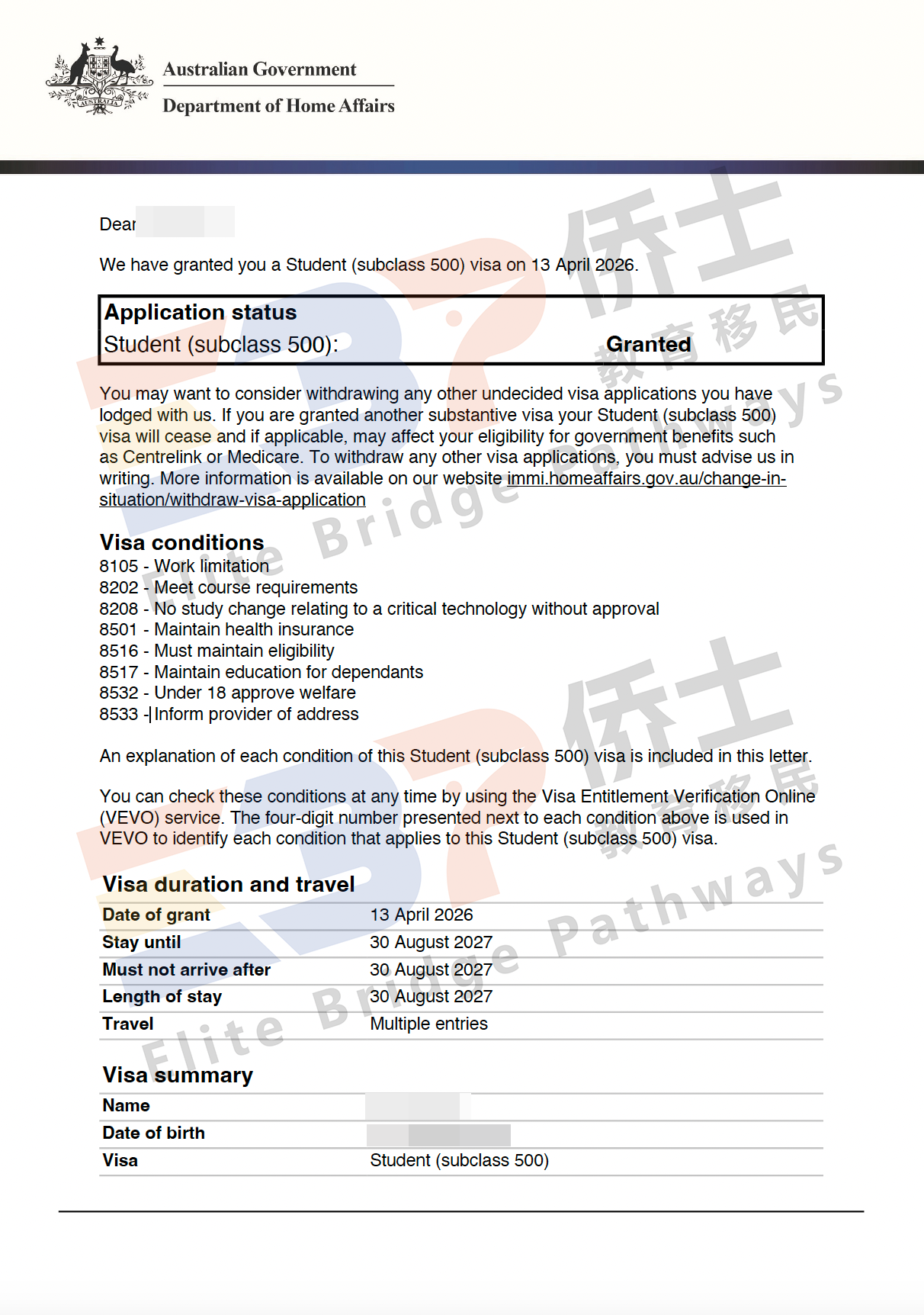
Many applicants get stuck when applying for an Australian Student Visa on one key requirement: GS (Genuine Student), previously known as GTE (Genuine Temporary Entrant).On the surface, it is just a set of short answer questions, but fundamentally, it determines whether you are assessed as a genuine student intending only to study in Australia.This guide breaks down the core logic of the GS statement and explains exactly how to answer each section.
1. Six Key Assessment Criteria for GS (Core Structure)
(1) Current Circumstances
- Family background
- Academic qualifications
- Work experience
- Financial situation
Core question: At your current life stage, why do you intend to study overseas?
Common mistake: Only stating basic information such as “I graduated from XX University”, without explaining study gaps or career changes to a new major.Correct approach: Present a clear chronological timeline (study → work → current application). Explain all gaps of 3 months or longer.
(2) Why Australia & This Education Provider
- Why not study in your home country or other countries?
- Why choose this specific major?
- Why choose this particular university/institution?
Core logic: Your choice must be reasonable and study-driven, not merely an excuse to migrate overseas. Best practice: Compare course content: home country vs Australia vs other countries Highlight teaching resources and practical opportunities Demonstrate clear relevance to your academic and professional background Critical note: A change of major must be fully explained. Official guidelines state that if your chosen course is unrelated to your previous study or work background, you must provide a detailed rationale; otherwise, you may be deemed to be using study as a pathway for migration.
(3) Future Benefits of the Course
- Intended future occupation
- Planned workplace location (emphasise returning to your home city after graduation)
- Expected salary and career development prospects
Core logic: Prove the course is a career investment, not a migration stepping stone. Common mistake: Vague generic statements such as “self-improvement” or “enhance employability”.
Correct writing structure:
Specify exact job role (e.g., Marketing Specialist)
Specify target city (e.g., Shanghai / Shenzhen)
Show a clear career pathway: Course learning → Skill acquisition → Future employment
(4) Other Supplementary Information (Optional but Highly Recommended)
- Explain any unusual personal or application circumstances
- Strengthen the overall coherence of your study plan
(5) Financials & Living Arrangements
- Source of funds
- Financial support from parents (if applicable)
- Planned accommodation and estimated daily living expenses
Core logic: Prove you can complete your studies legally without relying on unauthorized work or overstaying your visa.
Important Notes
- Overseas applicants: Provide sufficient bank deposit evidence
- Self-funded applicants with work savings: Submit historical income bank statements
(6) Immigration History
- Previous visa refusals
- Visa overstays
- Visa cancellations
Rule: Past immigration issues are not an automatic refusal, but all must be clearly explained.
2. Underlying GS Logic: A Coherent Career Timeline
All sections are assessed as one whole to verify the rationality of your life and career pathway.A qualified GS statement must form a continuous logical line:Past background → Current application → Future career plan
include:
- Bachelor of Marketing →
- 2 years working in sales →
- Master of Marketing in Australia →
- Return to home country to work as a Brand Manager
3. Most Common Reasons for Visa Refusal (Real Cases Summary)
1. Disconnected career pathway
- Switching from a business background to IT
- without reasonable explanation.
2. Dubious study motivation
- Content implying an intention to settle permanently in Australia.
3. Inconsistent supporting documents
- Claiming work experience in GS but lacking supporting proof;
- stating financial capacity that does not match bank records.
4. Unexplained study/work gaps
Official requirements mandate full disclosure and explanation of all employment or study gaps.